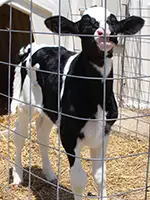
Refrigerating or freezing excess high-quality colostrum (greater than 22% Brix reading) is a great way to ensure each newborn calf receives this vital nutrition at birth. Because high temperatures can destroy immunoglobulins (IgGs) and other nutrients, colostrum should be carefully thawed and warmed before feeding it to the calf.
The owners of McAllister Family Dairy in New Vienna, Iowa, wanted to build a new calf care facility that could provide the best environment possible for raising healthy calves. When designing the facility, they focused on excellent ventilation and labor efficiency. In early 2022, calves moved into the new barn, which has space for 98 pre- and post-weaned calves. The farm managers are pleased with how the facility has met their goals in the last 18 months.
By Bethany Dado-Senn, Ph.D. | Both science and field work demonstrate that getting colostrum into calves within 2 hours of birth is a key part of ensuring adequate passive transfer of immunity. However, I often hear disputes on-farm on the best method for approaching this timely feeding. Is it better to feed colostrum via a bottle or esophageal feeder?
By Ann Hoskins | The options for calf hutches endless. The following considerations can help you research and choose hutches that best fit your farm and calf program.
Between 20 and 40 calves are born each day at Pagel’s Ponderosa Dairy, LLC in Kewaunee, Wisconsin. With exceptional animal care as a top priority on the farm, the team continually looks for opportunities to learn, evolve, and adopt new strategies to minimize stress – both for the animals and the employees – during each calving.
By Noah Litherland, Ph.D. | Whether you are thinking about building a new youngstock facility or renovating an existing facility, the following features can increase the functionality of the barn for both calves and calf caretakers.
By Noah Litherland, Ph.D. | When building or updating heifer facilities, producers must choose what feed barrier(s) to incorporate into the heifer pens. Consider these questions to help you identify the best option for your heifers and management system.
By Bethany Dado-Senn, Ph.D. | Of all the animals on your dairy farm, calves are the most susceptible to cold stress and require the most attention when facing winter weather. Fortunately, these tools can help you efficiently and strategically keep calves warm throughout the winter months.
Felten Farms in St. Cloud, Wisconsin, milks about 400 cows and raises all its heifers onsite with mostly family labor. Eric Felten takes the lead on calf feeding and care. He said he began exploring ways to improve calf management a couple of years ago to increase the efficiency and performance in this area of the farm.
In this edition of Calf Chat, Dr. Lucas Mitchell shares the three critical components of an integrated pest management (IPM) plan to reduce flies - and the stress and disease they can cause - in your youngstock operation.
Dr. Noah Litherland | A challenging heifer cycle occurs when a portion of the heifer development phase does not go as planned and results in heifers that have lower-than-expected rates of growth, lung consolidation, or increased rate of non-completion of first lactation. The net result is often a reduced return on investment from the heifer program. This article, the second in a two-part series, discuss the impacts of management, labor and facilities.
In this edition, Ann Hoskins, Vita Plus calf program manager, discusses the factors that affect passive transfer beyond how much IgG is fed to the calf.
By Dr. Lucas Mitchell, Vita Plus calf and heifer specialist
With the current state of feed prices, every penny counts and the importance of managing feed shrink in all areas of the dairy has been magnified. Here are five ways to manage feed shrink of calf feed.
"Consistency is very important to us when it comes to our calves. To make sure they get the same solids at every feeding, we weigh the milk replacer powder and water. This stand makes that job much easier." - Healther Schuld, Hasel Farms, Lake Mills, Wisconsin
By Ann Hoskins, calf program manager
Weighing calves is important in benchmarking and evaluating calf performance. In addition to growth rates, weighing calves can help you determine your cost of gain, which is key information for your calf nutrition and management program. Here are some examples of scales that can be used at various points in an animal's life to bechmark its growth.
In this edition, Ann Hoskins, Vita Plus calf program manager, walks us through two simple strategies to ensure your high-temp or batch pasteurizer is doing the job it is meant to do.