Click the subscribe button to sign up for any of our online resources.

When and why to contract feed
 By Les Lee, senior merchandiser, Loyal Ingredients LLC
With rising input costs, volatile milk prices and the ever-changing geopolitical world, managing commodity prices is not easy, but it can be done to help you protect your margins.
Let’s look at the “why” and “when” as it pertains to commodity price risks for your operation.
Why
The major benefit of contracting is to secure the supply of a particular commodity at a given price. For example, we have seen significant supply shortages for several ingredients this year; canola meal has been the most challenging.
Some will argue that having a contract in place doesn’t guarantee you the product. However, during supply issues, suppliers will prioritize customers with contracts over those without.
Reflecting on early 2026 headlines, we saw crude oil skyrocket to more than $120 per barrel and crash back down into the $80s in one 24-hour span. Volatility occurs for every commodity, and contracting helps mitigate those price risks.
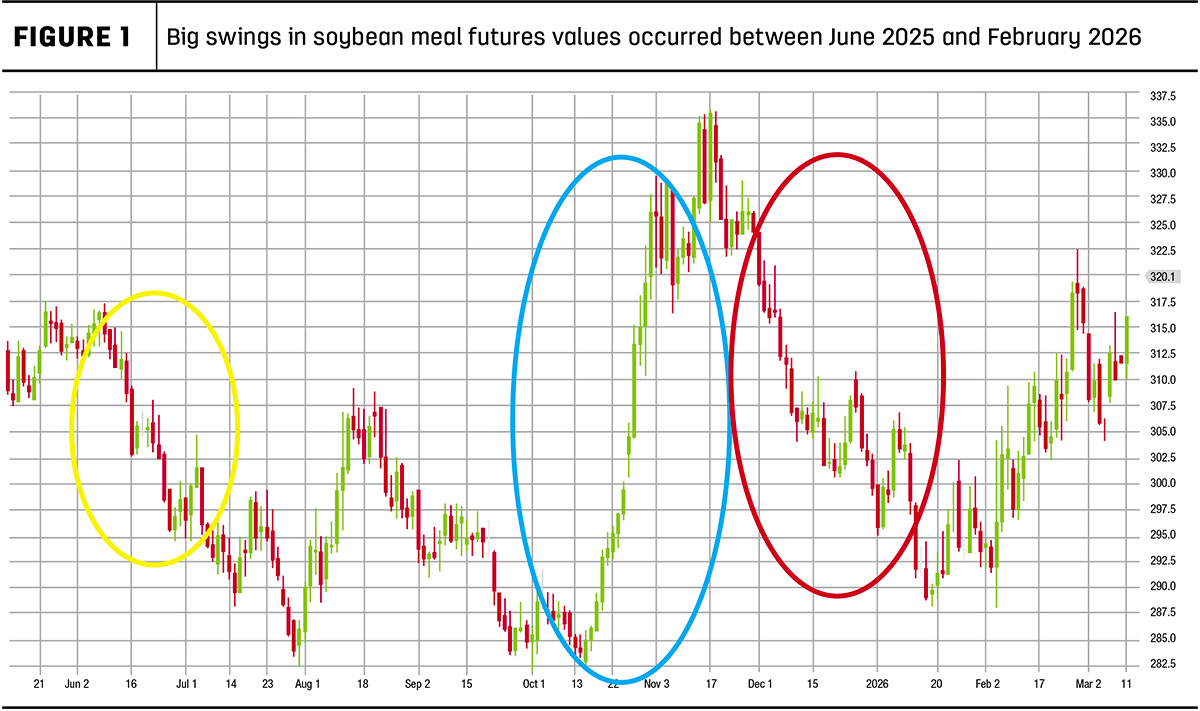
In the soybean meal futures chart (Figure 1), in mid-June 2025, the EPA released the first renewable diesel projections for 2026, resulting in soybean oil values increasing and soybean meal futures decreasing (yellow circle). Conversely, when President Trump reached an agreement with China for soybeans, soybean meal rallied (blue circle). After that, the market was overbought and turned bearish (red circle). During this span from June 2025 to February 2026, the low soybean meal board price was $282.70, and the high was $335.80. Those swings can significantly impact profitability at the farmgate if exposed to the market.
One final why that needs to be highlighted is margin protection, which is also related to the when discussion. If you use milk marketing tools to protect revenue, then contracting your commodities at the same time can help lock in profitability. If not, then you are still exposed to margin risks.
When
First, let’s consider fiber sources such as cottonseed, corn gluten feed, soyhulls, etc. Historically, these ingredients have been contracted pre-harvest. Once harvest is complete, the true size of the crop is realized, and that can significantly impact the value of the crop, especially if it is smaller than expected. Additionally, demand for many ingredients ramp up as you head into the holiday season, resulting in higher prices and potential supply shortages.
Next, we’ll consider protein sources. Because soybean meal and canola meal are tied to global trades, the historically good times are much harder to identify. Although a large portion of protein sources are contracted during the summer and fall months (similar to the high-fiber commodities), this is not always the best time to contract.
Cash prices consist of two components — basis value and futures price. Both components of the cash price will present opportunities to contract, but not always at the same time. For example, basis values at local processing plants historically turn bearish during and immediately after harvest.
Conversely, scheduled maintenance downtime at the plants will undoubtedly cause basis values to strengthen.
Lastly, the futures market for soybean meal on the Chicago Mercantile Exchange (CME) can sometimes seem like the Wild West. The funds (institutional investors and funds that actively manage money for clients) that buy and sell the commodity probably alter these values the most.
Figure 2 is the same chart as before, but with a couple of indicators included to help identify extreme values. The black arrows illustrate that the market was overbought and then turned bearish with values receding. The green arrow illustrates the opposite; the market was oversold, indicating a potential bullish trend for higher values, which occurred.
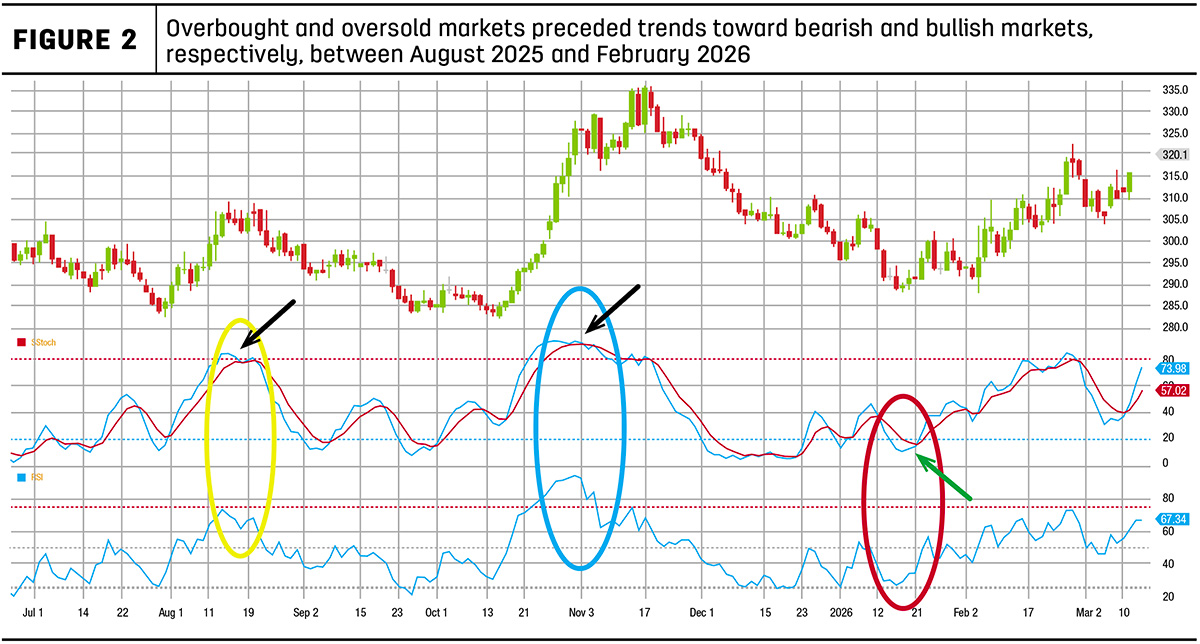
Monitoring and identifying when the market is overbought or oversold can help indicate the futures price could correct itself. However, that does not mean the market will do so immediately.
Summary
Trying to predict the low or the high in the commodity world is impossible and extremely risky. Taking a critical look at your operation and committing to the why will help you develop strategies to tackle the when part of the equation.
Loyal Ingredients LLC is part of the Vita Plus group of companies. Email Les Lee. This article was originally published on June 25, 2026, by Progressive Dairy. Click here to read more.
| Category: |
Business and economics Dairy Performance Feed additives Forage storage and management Silages |