
Click the subscribe button to sign up for any of our online resources.

Starch digestibility: Give it time
Posted on October 1, 2013 in Dairy Performance
 By Dr. Eric Schwab Here’s a question for you: When you’re feeding high-producing dairy cattle, do you want to feed the rumen bugs or the wildlife? If you’re an avid hunter in search of big bucks or long-bearded turkeys, the latter might not sound so bad. But when corn prices hover around $6 per bushel, you (and your cattle) would probably be better served feeding the rumen and leaving the wildlife to fend for themselves. Starch, delivered as grain or silage, is best utilized if it’s fermented in the rumen where the microbial population can put it toward growth and energy production. The three main factors influencing start digestibility from corn grain and corn silage are (1) processing and particle size, (2) maturing and moisture content, and (3) time. As most of us are wrapping up corn silage harvest, we’ve already done what we can in terms of processing, particle size, maturity and moisture content. However, we can still focus on these areas during grain harvest. See the table below for specific targets and notes. For now, let’s focus on the third factor: time. Time is a great ally in improving starch digestibility. You’ve probably experienced the phenomenon that, as corn silage and high-moisture shelled corn (HMSC) age, they seem to “feed better.” On the flip side, when young corn silage replaces aged corn silage soon after harvest, milk yield often drops. Several controlled studies have shown that starch digestibility for both corn silage and HMSC improves dramatically with time ensiled. That’s due to the presence of protease enzymes that break down prolamin-zein protein subunits, which hold starch granules together. Prolamin-zein proteins encapsulate corn starch and act as a barrier to digestion. The catch here is to have an ample corn silage inventory so carryover lasts into January or February of the following year. After four to five months, starch digestibility in corn silage should approach its maximum. In regards to HMSC, carryover is definitely a good idea. However, the issue of practicality comes into play as research has shown that, at eight months to more than a year in storage, HMSC digestibility is still improving. The importance of achieving optimal starch digestibility can be shown with some simple but realistic napkin math. Let’s assume a 26-percent starch diet is fed to cows consuming 57 pounds dry matter intake. If total tract starch digestibility was improved by 10 percent, 1.5 pounds of starch dry matter would no longer pass through the cows. Equating this to dry corn equivalents at $6 per bushel for corn, this 1.5-pounds dry matter starch has a value of $0.27 per cow per day. And we have not even accounted for any possible gains in lactation performance. This fall, make sure all is in place to for your starch to be as digestible as it can be. Although the wildlife might not like it, your cows and your wallet will.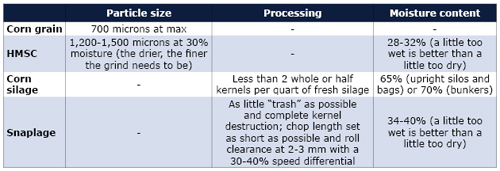
 Work with your consultant to develop strategies for improving starch digestibility that best fit your farm. This article was originally written for the Sept. 21, 2013 edition of Progressive Dairyman. About the author: Dr. Eric Schwab grew up in a rural town in New Hampshire. He attended the University of New Hampshire – Durham, where he received bachelor’s degrees in dairy management and environmental and resource economics in 1998. While working in northeast Wisconsin, he met Dr. Randy Shaver and returned to academia at the University of Wisconsin – Madison to pursue his graduate degrees. In Shaver’s lab, Schwab’s master’s degree research focused on kernel processing and chop length in BMR corn silage. His Ph.D. dissertation focused on B vitamin nutrition and ruminal B vitamin synthesis in lactating dairy cows. In September 2005, Schwab joined Vita Plus on the dairy nutrition and technical services team. He lives in Rice Lake, Wis. with his wife and their two sons.
| Category: |
Dairy Performance Feed quality and nutrition Forage storage and management |